“Nature intended women to be our slaves. They are our property”
-Napoleon Bonaparte
Do you wonder what life could be like if we could rewrite the rules? Not the flashy ones to plaster over billboards and TV screens, but the quiet ones that have practically shaped the way we think. It’s as though we’ve been playing by someone else’s rules all along, and we’ve only just started to realize it.
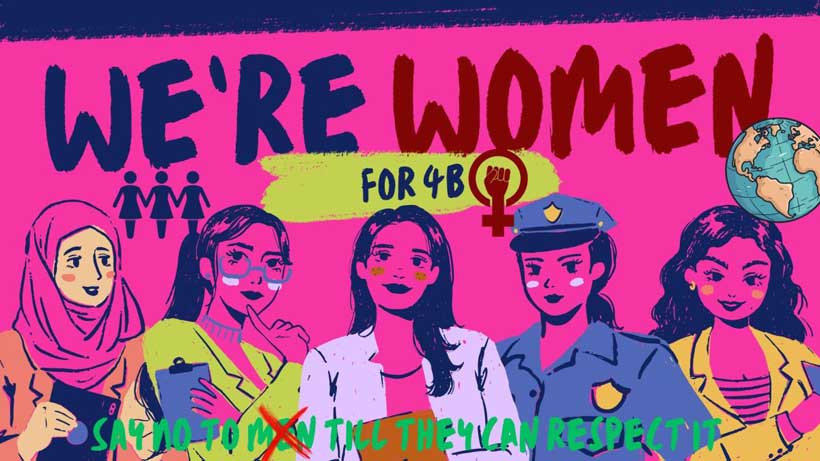
The endless “what ifs” keep me awake at night, contemplating new possibilities. That’s when I discovered the 4B movement
For those who don’t know, 4B stands for:
Bi, means No.
- Bihon – no heterosexual marriage.
- Bichulsan – no childbirth.
- Biyeonae – no dating
- Bisekseu – no heterosexual relationships.
4B isn’t another trend destined to fade. It’s a power move – a rallying scream for help. These four words reject the norm, destroy the beliefs we’ve been asked to accept as gospel, and unfurl possibilities of something radically different.
“The words an works of God is quite clear, that women were made either to be wives or prostitutes”
-Martin Luther
This notion, though archaic has influenced centuries of traditions and ways of thinking. Under the romanticised idea that they sell of love, togetherness and ‘partnership’ lurks a dark reality:
Love, often idealised as pure and fulfilling, can also serve as a manipulator, affection a tool of control, and partnership a gilded cage. These sweet promises of fulfillment often come steeped in unspoken expectations that quietly erode autonomy and freedom. It’s time we question these norms and re-imagine what true equality and connection looks like.
Did you know, nearly two in five (37 percent) married women have experienced some form of physical or sexual violence by their husband?
An average of 24 people per minute are victims of rape, physical violence or stalking by an intimate partner in the United States — more than 12 million women and men over the course of a single year.
The 4B movement is just one response to a society where women face violence and control at every turn. For many, even leaving a relationship comes with life-threatening risks. In South Korea, breaking up is far more dangerous than it should be. It is not as simple as walking away.
This is where I was truly baffled.
The term ‘safe breakup’ refers to ending a relationship safely without stalking, violence or threats. Women shared how they carefully avoided revealing details about their family, fearing that, in event of a breakup, their family could be harmed. What is love if you have to fear the one you’re supposed to love?
The Korea Women’s hotline has reported that at least 138 women were killed by their husbands or boyfriends in 2023. An additional 311 women survived attempted murder. According to the hotline, a woman faces the risk of being killed by her husband or male partner every 19 hours in South Korea.
Earlier this month, a 25-year-old medical school student, identified by his surname Choi, was arrested on charges of stabbing his girlfriend to death on the rooftop of a building in southern Seoul on March 6.
Choi, who has admitted to having premeditated the murder, reportedly told police he had committed the crime after his girlfriend told him she wanted to break up.
With violence on the rise, so is the fight to be free !
While South Korea’s declining birth rate of 0.68 births per woman (as of 2024) cannot be attributed solely to the 4B movement, it reflects a broader rejection of societal structures tied to inequality. they are more or less tied to inequality. Some factors include gender inequality, declining marriage rate, government policies, work life imbalance etc.
This movement particularly gained traction among women in the United States during a period marked by the election where Donald Trump and the overturning of Roe v. Wade, which stripped women of their right to abortion, served as a wake-up call, reminding the fragility of women’s autonomy and the urgent need for change.
“Each time a woman stands up for herself, without knowing it possibly, without claiming it, she stands up for all women.”
Maya Angelou
The 4B movement is only the beginning- it is a response to a system that fails women at every level. They are reclaiming their power and rewriting history, one where they are not puppets dancing on the strings of patriarchy. It isn’t a war against men, but about building a future where everyone, regardless of gender, can thrive on their own terms
Source:
2010 Summary Report. Atlanta, GA: National Center for Injury Prevention and Control, Centers for Disease Control and Prevention.
https://dspmuranchi.ac.in/pdf/Blog/domestic%20violence.pdf
https://www.koreatimes.co.kr/www/nation/2025/01/113_374879.html
Leave a Reply