“It’s like having a flower, or a rose. You water it and keep it at home for yourself, to look at it and smell it. It [a woman] is not supposed to be taken out of the house to be smelled.“
-Syed Ghaisuddin, Taliban Minister of Education, when asked why women needed to be confined at home
Are women roses? Are we animals? Are we considered living at all, or are we just warm incubators equipped with the ability to cook and clean?
Because that is the reality millions of women and girls face in Afghanistan today.
While walking outside, interacting with others, and enjoying a park are ordinary activities for many of us, these simple acts are monumental acts of courage for Afghan women.
The world has never witnessed such a severe erosion of women’s rights as we have since the Taliban’s return to power in Afghanistan in 2021. Women and girls have been stripped of their rights, voices, and dignity, reduced to mere shadows of their former selves. They are forced to communicate silently in a desensitised world that is blind to their suffering and deaf to their cries.
According to Human Rights Watch, the Taliban have created the most severe women’s rights crisis in the world since taking power. Afghanistan has become the first country in the world to forbid secondary and higher education to girls and women – a first that should be unthinkable in the twenty first century.
Taliban has replaced the Ministry of Women’s affairs with the ‘Ministry for the Propagation of Virtue and the Prevention of Vice’, enforcing convoluted interpretations of Islamic principles. They brazenly targeted women, mandating face and body coverings, and forced them to leave their jobs.
The Taliban have systematically removed women from public life, crippling them financially and confining them to their homes. They have stripped women of their identities and autonomy by enforcing strict dress codes and even silencing their voices
Women are not even allowed to be heard outside of their houses – not even through walls – instead, they must use sign language to communicate in public. They are prohibited from singing, poetry recitals, and even public interaction. All this for the ‘fear of temptation’. How long will women suffer because men are unable to control their ‘urges’? How long will we be the victims of a system that was built to marginalise women?
“Today, I am imprisoned in my own home simply for being a woman. Worse yet, I faced severe security threats that have forced me to leave my home. The place I lived for years, where I was respected by everyone, no longer had a place for me. … In the blink of an eye, I went from the throne to the ground, and the day came when I couldn’t even afford 10 afghanis for transportation.”
As a defence lawyer, Joweria used to take on women’s and children’s rights, child marriage and domestic violence cases. Now, she can no longer practice law.
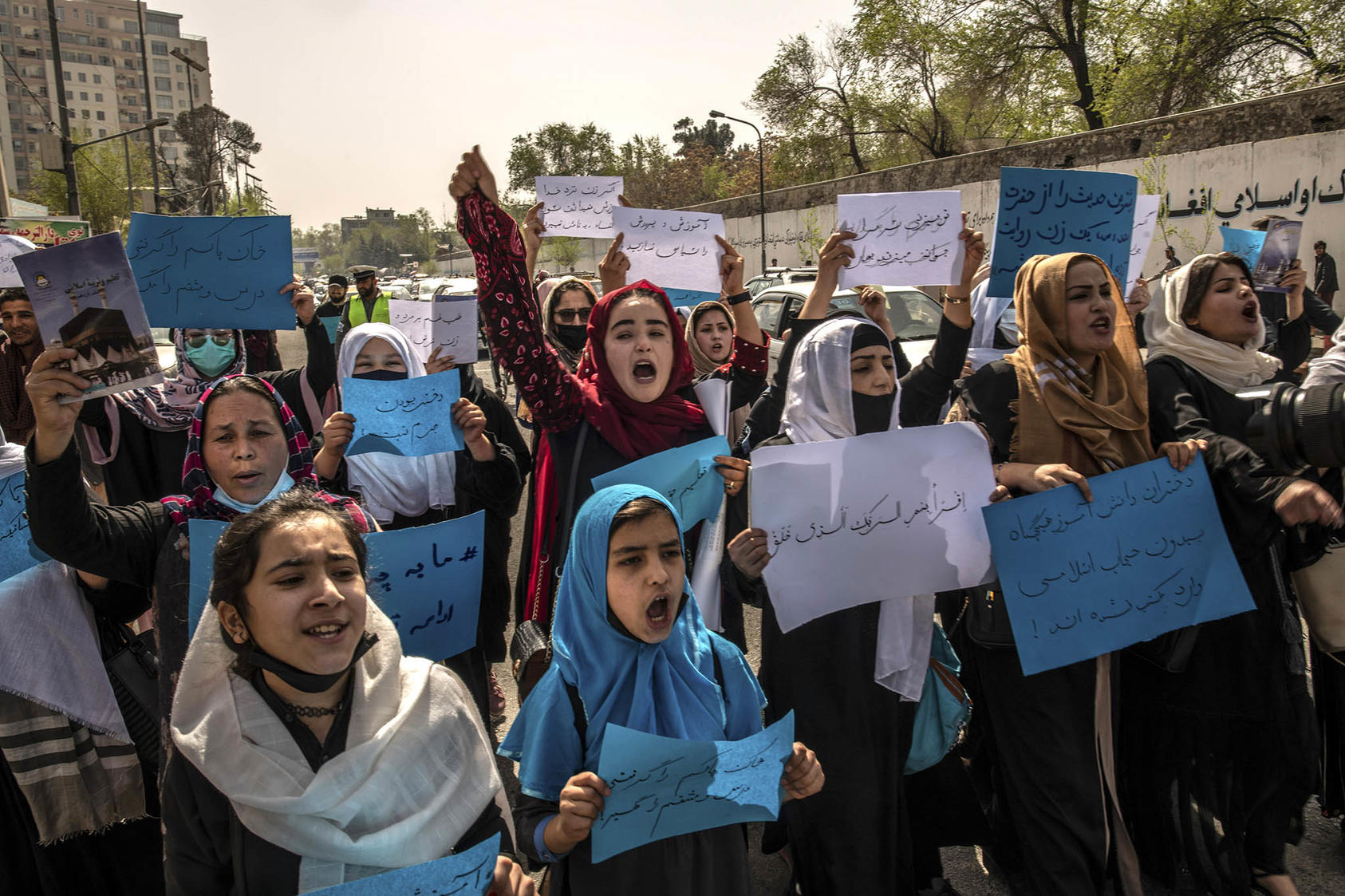
But the brave, resilient, daring Afghan women have not given up. They have fought fire with fire. After the voice ban, they have flood the internet with videos of them singing, boldly protesting against these outrageous draconian laws.
“You placed the stamp of silence on my mouth until further notice. You will not provide me with bread and food until further notice, you’ve imprisoned me inside the house for the crime of being a woman”
-sung by one of the women in the viral video
Fatana, another fierce protester, was a student and vice president of a youth union in Nuristan, is now dedicated to the cause of fighting these shackles placed on women, determined to raise voices in the hope that the world finally acts!
Joweria, a defence lawyer has been giving educational opportunities to many girls who were robbed from their right to literacy.
Sohalia, a former parliamentary reporter from Takhar – now unemployed – has been collecting and sharing stories of women online, being the voice of several women who have not been heard, and ensuring that they are.
There are just few of the many dauntless, valiant and relentless Afghan women. They will not be silenced and they will not be shunned. Now it is on us to respond to their pleas, and help them overcome this siege of darkness, making sure it is an example to all those around the globe fighting against women and their rights.
“I want to raise the voices of these innocent women to the international community, so that it no will longer just monitor and react, but act instead—act for the benefit of the brave women of my country, because we do not get anything from reaction! … My message to the world is to raise your voice with us, women, and don’t be silent. …
“Despite all the restrictions and torture, we women have not given up and we will not! … We have been projecting our voices more into the world, and we will continue on this path with our other sisters until the last moment of our lives.”
– Says Fatana, a student and vice-president of a youth union in Nuristan

Leave a Reply